
AI in Education: A Tool, Not a Solution

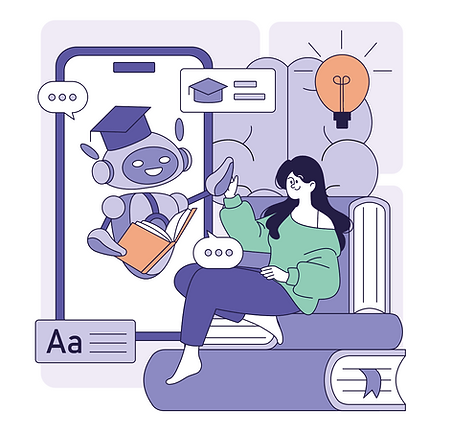
Used wisely, artificial intelligence doesn’t replace thinking, it stretches it. The real magic happens when technology supports curiosity, discipline, and human guidance rather than substituting for them. In today’s classrooms, AI is becoming more common, more powerful, and more accessible. The real question isn’t whether students will use it. It’s how they will use it.
When treated as a tool, not a solution, AI can strengthen learning in remarkable ways. Especially when you have a teacher or tutor who is trained to help guide students in the process.
AI & Math: Supporting the Process
AI can assit with explanations, not just the answer.
Another powerful strategy is error analysis. A student solves the problem first, then asks AI to check the work and explain mistakes. This builds the ability to understand one’s own thinking. Strong math students naturally review their reasoning. AI can help others develop that same habit.
AI can also expose students to multiple strategies. A problem solved algebraically might also be approached graphically or logically. Seeing different pathways strengthens conceptual understanding and flexibility.
AI and Writing: Preserving the Student Voice
Writing presents a similar opportunity. AI can generate full essays in seconds, but that shortcut comes at a cost. When students skip the thinking, they skip growth.
Used properly, AI becomes a brainstorming partner.
Instead of writing the paper, AI can help refine it. A student might submit a paragraph and ask, “How can I make this clearer?” or “Where is my argument weak?” The key is reflection. Students should explain why they accept or reject suggestions. That is where real learning happens.
AI is also excellent for revision coaching. It can identify vague wording, suggest stronger transitions, or check tone consistency. But it should never replace the student’s voice.
Where the Tutor Makes the Difference
AI has knowledge. A tutor has care, insight, and guidance.
Technology can explain a concept. It cannot read a student’s frustration. It cannot sense hesitation. It cannot build confidence after repeated struggle.
As a tutor, my role is not to compete with AI but to teach students how to use it wisely. I relate to students through knowledge and compassion. I show them how to draft independently first, use AI second, and reflect third. I teach them a simple framework. This structure protects the learning process.
Preventing Dependency
The way to prevent AI misuse isn’t banning it, but redesigning learning. When students know they will need to explain their reasoning, they are far less likely to outsource their thinking. Institutions use detection tools such as Turnitin and ChatGPTzero to easily check for AI-generated work or other forms of academic dishonesty.
When guided well, AI reduces frustration, increases independence, and builds confidence. It supports struggling learners and challenges advanced students. But without guidance, it creates shortcuts that weaken resilience.
The future of education isn’t human versus machine. It’s human plus machine.
AI can provide information.
A tutor provides direction.
AI can generate ideas.
A tutor develops judgment.
AI can give answers.
A tutor builds thinkers.
And in a world where answers are everywhere, the ability to think deeply matters more than ever. I would love the opportunity to assist your children as learns and become better thinkers, confidence, and ready for the next challange.
Wendy Steele Betron is the owner and lead educator at Steele’s Scholars. A former classroom teacher with over 30 years of experience in education and tutoring, she specializes in helping students build confidence, close learning gaps, and reach their full potential.


Comments